

Options for Lightweight Materials in Product Design
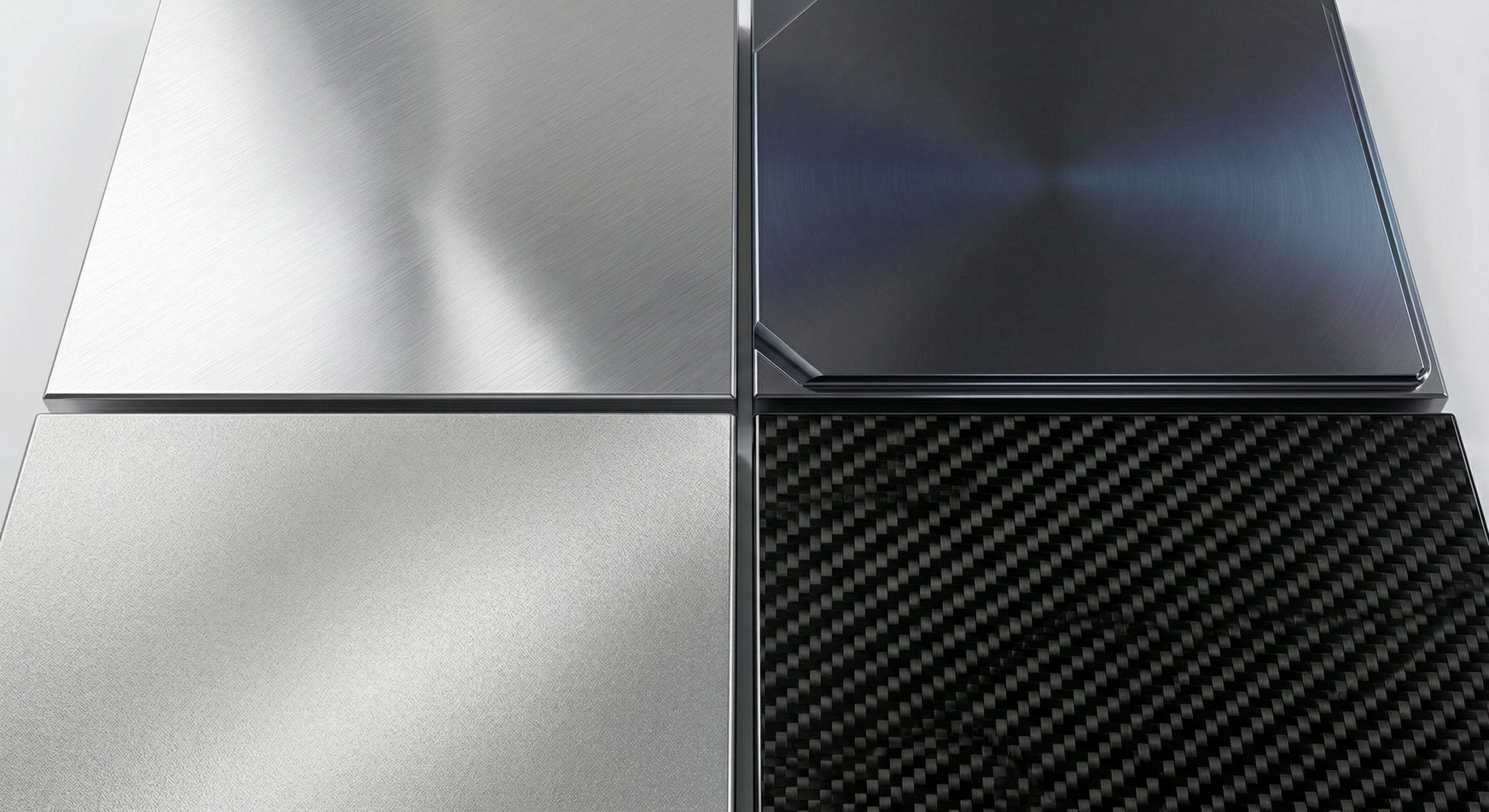
When you’re designing a product and weight is the enemy, you’ve got choices. But those choices aren’t all created equal — and understanding the fundamental differences between your material options is what separates a good design from an expensive mistake.
If you’re an engineer or product designer exploring lightweight materials, you’ve probably already looked at metals, plastics, and composites. Maybe you’ve got a part made out of one material and you’re wondering if you can convert it to something lighter. That’s a conversation we have almost every week. And the first thing we tell people is this: these materials aren’t just different weights — they’re fundamentally different in how they’re constructed, how they behave, and how you have to think about designing with them.
Let’s walk through your options.
Metals: The Familiar Starting Point
Most engineers cut their teeth on metals, and for good reason. Metal is made out of crystals, and its strength comes from those crystals. You can heat treat it, alloy it, and adjust properties to get what you need. And here’s the thing that makes metals so approachable — they’re what we call isotropic. That means if you had an XYZ grid inside your part, the properties in X, Y, and Z are pretty much the same. It doesn’t matter which direction you look at it.
What that means practically is that if you want to make something out of metal, you just get a chunk of it and machine away everything that isn’t what you want. You can beat it, form it, forge it, roll it out thin. It’s malleable. And if you overload a metal part — say a pilot pulls too many Gs on an aluminum wing — it probably won’t break. Something will stretch, the wing might come back just slightly bent, but it’ll be fine. Metal is forgiving that way.
For lightweight applications, aluminum alloys are often the go-to. They offer good strength-to-weight and machinability. Titanium pushes that further with better corrosion resistance and a higher strength-to-weight ratio, though at a significantly higher cost. And magnesium alloys are even lighter, though they come with their own challenges around corrosion and flammability.
But here’s the limitation: even the lightest metals are still, well, metal. You’re limited by the density of the material itself. You can thin it out, you can optimize geometry, but you’re working within the bounds of an isotropic solid. And for a lot of high-performance applications, that’s not enough.
Plastics: Light, But Limited
Plastics take a completely different approach. If you want a good mental image of what plastic is, think of a plate of spaghetti that sat out too long and all stuck together — yesterday’s spaghetti sitting on the table, now a solid block. That’s essentially what you’ve got: long chain polymers tangled up together, and the strength comes from the length of those chains. Low density polyethylene is short molecules, high density polyethylene is long molecules.
Plastics are light. No argument there. And they’re versatile — you can injection mold them, form them, even 3D print them. For products where structural performance isn’t the primary concern, plastics are often the most cost-effective lightweight option.
But plastics don’t have the structural performance that metals do, and they definitely don’t compete with composites. You can’t alloy them the way you do metals. They don’t have crystalline structure to manipulate. And while they can be formed with heat, they have limitations around temperature stability — some get soft gradually, others hit a temperature and go liquid almost instantly.
For lightweight product design, polycarbonate, nylon, and PEEK are common choices depending on your performance requirements. Fiber-reinforced plastics — chopped glass or carbon mixed into the polymer — can improve stiffness and strength, bridging the gap between pure plastics and full composites. But they’re still fundamentally different from what we’re about to talk about.
Carbon Fiber Composites: A Different Animal Entirely
Here’s where things get interesting, and where most of the misunderstanding happens.
Carbon fiber composite is not a lighter version of metal. It’s not a stronger version of plastic. It’s a fundamentally different material that requires a fundamentally different way of thinking about design.
A carbon fiber composite is a mixture of fibers and resin. The purpose of the resin — typically epoxy — is to bind the fibers together. The strength of the resin itself isn’t very great. All the strength is in the fibers. Think of it like wood: the fibers run along the trunk of a tree, giving it tremendous strength in bending. That’s why a palm tree can bend nearly horizontal in a hurricane and snap right back up when the wind stops. The fibers are doing all the work.
Carbon fiber is anisotropic — its properties change depending on which direction you’re looking. If you line up all the fibers in one direction (that’s called unidirectional), you get incredible tensile and compressive strength along those fibers. But across them? It’s basically just a chunk of epoxy. Not much to write home about.
So engineers learned to weave fibers in multiple directions. A 0/90 fabric gives you strength in two perpendicular directions. Add fibers at ±45 degrees and you get what’s called quasi-isotropic — pretty good strength in almost all directions. It’s an optimization, and it’s the basis for most structural composite design.
Why Carbon Fiber Excels at Lightweight Design
When you’re comparing lightweight materials, you need to think about three measurements: strength, stiffness, and weight. And more importantly, the ratios — strength-to-weight and stiffness-to-weight.
Carbon fiber has high strength-to-weight, but it has even better stiffness-to-weight. That’s a critical distinction. For many applications — precision instruments, robotics, aerospace structures, sporting equipment — stiffness is what you’re actually designing for. You want to know: at this load, how much will it deflect? And carbon fiber lets you hit those deflection targets at a fraction of the weight of metal.
It also has an incredibly low coefficient of thermal expansion — roughly half a millionth of an inch per inch per degree Fahrenheit, compared to aluminum’s fourteen millionths. For applications where dimensional stability matters across temperature changes, that’s a massive advantage.
What Makes It Challenging
Carbon fiber is brittle. If you take a steel rod and pull on it, you’ll feel it stretch, give a little, and eventually deform before it breaks. Carbon fiber doesn’t do that. It pulls linearly until it hits its ultimate strength, and then it just pops. No warning, no graceful deformation, no bending and going back to service.
That means stress concentrations are a real concern. You can’t just drill holes through a composite part and bolt things together the way you would with metal — you cut the fibers, and suddenly there’s no strength near that hole. Connections have to be designed differently, usually with bonded joints and generous glue areas.
And here’s something that surprises a lot of people coming from metal design: you can’t just take a block of carbon fiber and machine away everything that isn’t your part. That’s not how it works. Carbon fiber is molded, built up layer by layer. You’re essentially constructing the material and the part at the same time. The layup schedule — the specific sequence and orientation of fiber layers — is integral to the design.
This means that when you design a carbon fiber part, you don’t just design the part. You design the process to fabricate it. That’s very different from metal, where you can just hand someone a drawing and say “go machine it.”
The Shell Structure Advantage
Because you’re building with layers of fiber, composite parts are naturally shell structures. And that’s actually a tremendous advantage. Some of the highest-performing structures in nature and engineering are shells — monocoque structures. Bird bones, eggs, insect exoskeletons, airplane fuselages, race car tubs. Shell structures are inherently high strength-to-weight.
With metal, building a monocoque means rolling material thin, wrapping it, riveting it onto frames — a lot of work. With carbon fiber, you make a mold and lay up the material directly into whatever shape you need. Complex curves, swoopy aerodynamic surfaces, integrated features — things that would be prohibitively expensive in metal become practical in composite.
Emerging Lightweight Materials
Beyond these three primary categories, the materials landscape continues to evolve. Graphene-enhanced composites promise even higher strength-to-weight ratios, though commercial applications are still developing. Ceramic matrix composites offer extreme temperature resistance for specialized applications. And advanced foam core sandwich structures — using lightweight cores bonded between composite face sheets — can deliver remarkable stiffness at minimal weight.
Choosing the Right Material for Your Application
The right lightweight material depends entirely on your specific design requirements. Here’s the practical way to think about it:
If your loads are moderate and cost is the primary driver, reinforced plastics may be your best bet. If you need well-understood, predictable performance and your weight targets aren’t extreme, aluminum alloys give you a solid foundation. But if you need the best possible stiffness-to-weight or strength-to-weight, if thermal stability matters, if you’re willing to think differently about how your part is designed and manufactured — carbon fiber composite is where you want to be.
The key is working with people who understand these materials at a practical level. You can read books about carbon fiber and learn 80 to 85 percent of what you need. It’s that last 15 percent that’ll bite you. There are strange things, weird behaviors that you only learn by making parts — lots of them — over many years. Understanding the feel of how epoxy wets out, knowing how to prevent voids, designing layups that are balanced and symmetrical, managing the nuances of bonded joints and thermal effects — that’s where experience matters.
Ready to Explore Carbon Fiber for Your Product?
If you’ve got a part made from metal or plastic and you’re wondering whether composite could do the job better, lighter, or stiffer — that’s exactly the conversation we like to have. We don’t just build to print. We help engineers who understand their design requirements but need guidance on how to translate those into composite. We’ll teach you what you need to know, prototype it, let you test it, iterate, and get it right.
Because that’s how you want to build your product. One step at a time, with people who’ve been doing this for over 30 years. Learn more here.
Frequently Asked Questions
What are some lightweight materials used in product design? The most common lightweight materials include aluminum alloys, titanium, magnesium, engineering plastics like polycarbonate and PEEK, fiber-reinforced plastics, and carbon fiber composites. Each offers different tradeoffs between weight, strength, stiffness, cost, and manufacturability.
What materials are used for lightweight and high-strength structures? For the highest strength-to-weight and stiffness-to-weight ratios, carbon fiber composites lead the field. Titanium alloys and advanced aluminum-lithium alloys also perform well. The choice depends on your specific structural requirements, operating environment, and budget.
What are the lightest structural materials available? Carbon fiber composites are among the lightest structural materials, especially when used in shell or sandwich configurations with foam or honeycomb cores. The material’s density is roughly 60 percent that of aluminum, but its stiffness-to-weight ratio can be several times higher.Can I convert an existing metal or plastic part to carbon fiber? You can — but it won’t look the same. A carbon fiber part needs to be designed for composite, not just swapped material-for-material. The geometry, connections, load paths, and manufacturing process all need to be rethought. That’s
View All Articles
Carbon Fiber Specialists